A platform for continuous management of cyber exposure
Discover, prioritize, validate and resolve every critical exposure in a single CTEM cycle. Passive and active discovery, contextual risk scoring, guided remediation.
The first CTEM-native Italian platform
A CTEM-native platform for continuous attack surface management
Galileo implements Gartner's Continuous Threat Exposure Management framework: five consecutive phases in a continuous and automated cycle.
From initial scoping to remediation plan, a dedicated engine for each phase
In a fragmented and dynamic digital ecosystem, visibility is the first form of defense
Your company's attack surface is constantly evolving.
This dynamism introduces visibility gaps and exposure risks that traditional management models struggle to intercept.
Galileo automatically identifies all assets in your digital perimeter, including unmanaged or forgotten ones — a byproduct of cloud migrations, SaaS adoptions, or post-M&A integrations.
In the wrong hands, a compromised credential can become a way in
An exposed identity can become access.
The risk starts outside the perimeter, but it can reach the services your organization relies on.
- Compromised credentialA corporate identity appears in a monitored source.
- Use by an attackerThe credential could be used to appear as a legitimate user.
- Unauthorized accessAnother possible entry point to accounts and services.
Galileo detects compromised credentials associated with your organization and provides the right context to act before they are exploited
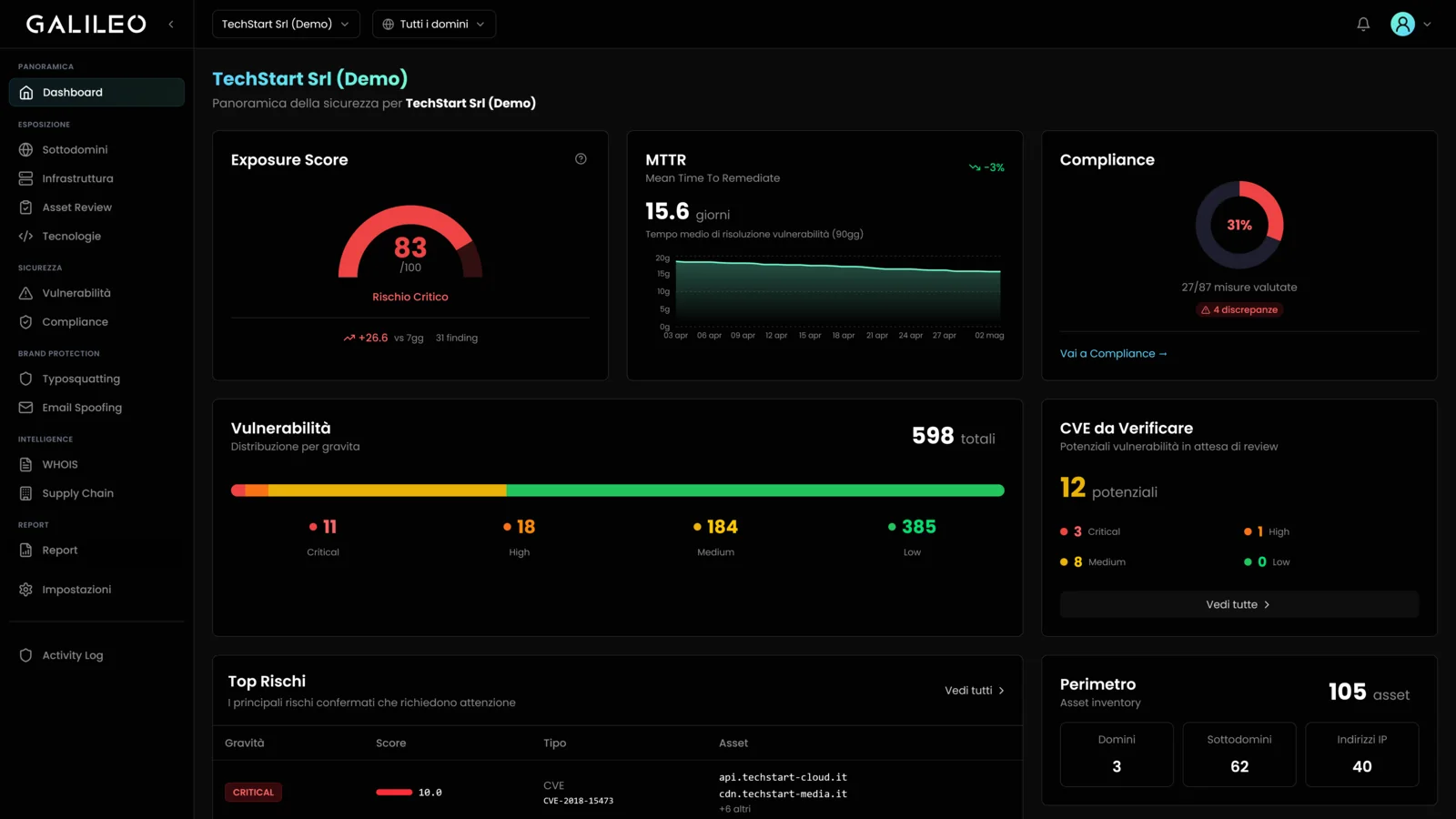
Give priority to what really matters
Treating every alert with the same urgency means burning energy on marginal risks while critical exposures stay open.
Galileo applies a contextual risk-evaluation model that combines standard vulnerability metrics with parameters tailored to your company.
Traditional systems treat all alerts the same way. Galileo puts your company at the center.
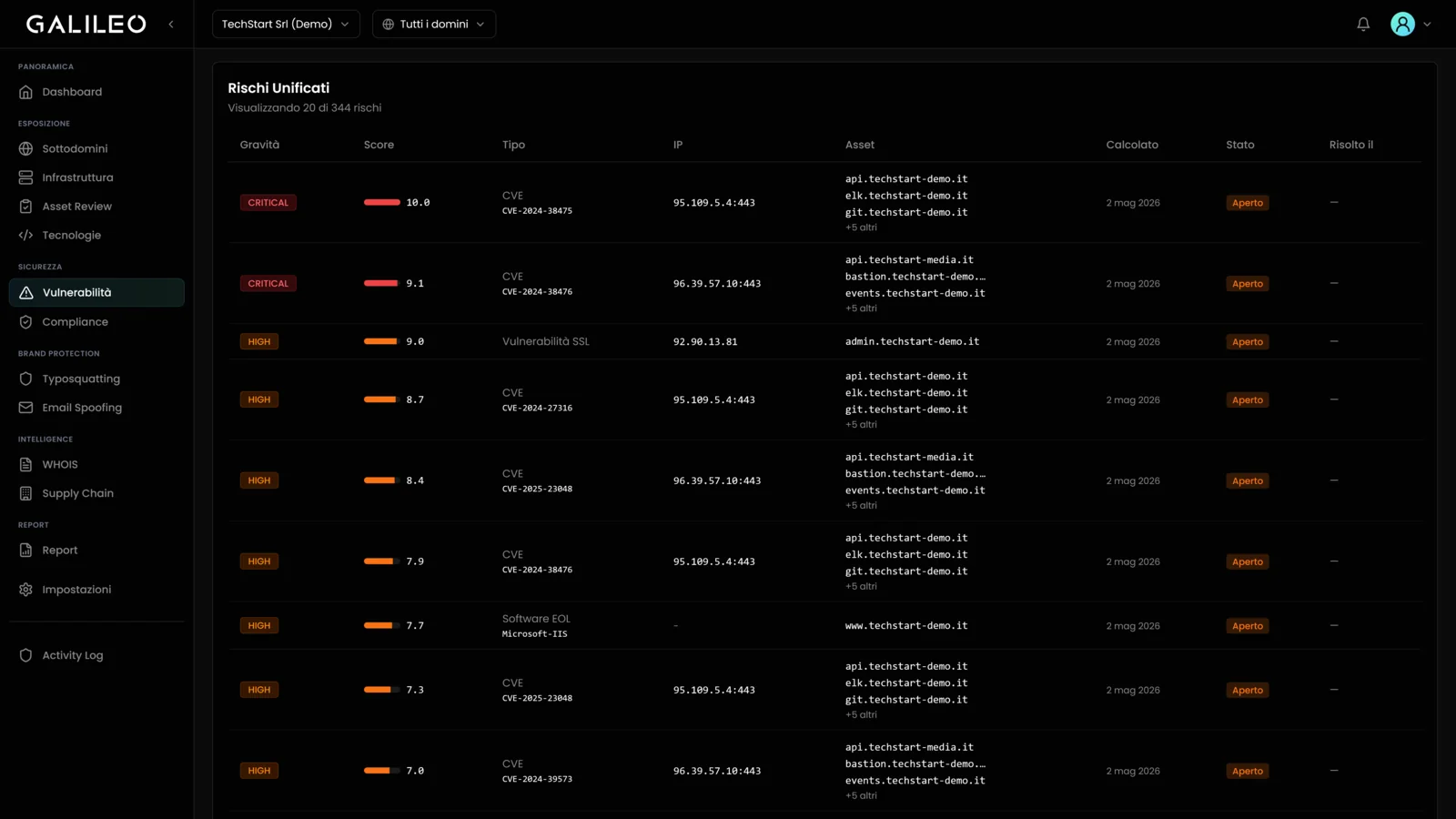
Resolve criticalities before they become attack vectors
Identifying critical exposures is only the first step.
Traditional external-surface management tools stop at identification, leaving security teams uncertain about how to intervene effectively.
Galileo changes the paradigm, translating external-surface analysis results into operational resolution instructions. A remediation engine based on advanced decision models and Agentic AI that associates every exposure with an action plan, providing precise technical guidance for risk reduction.
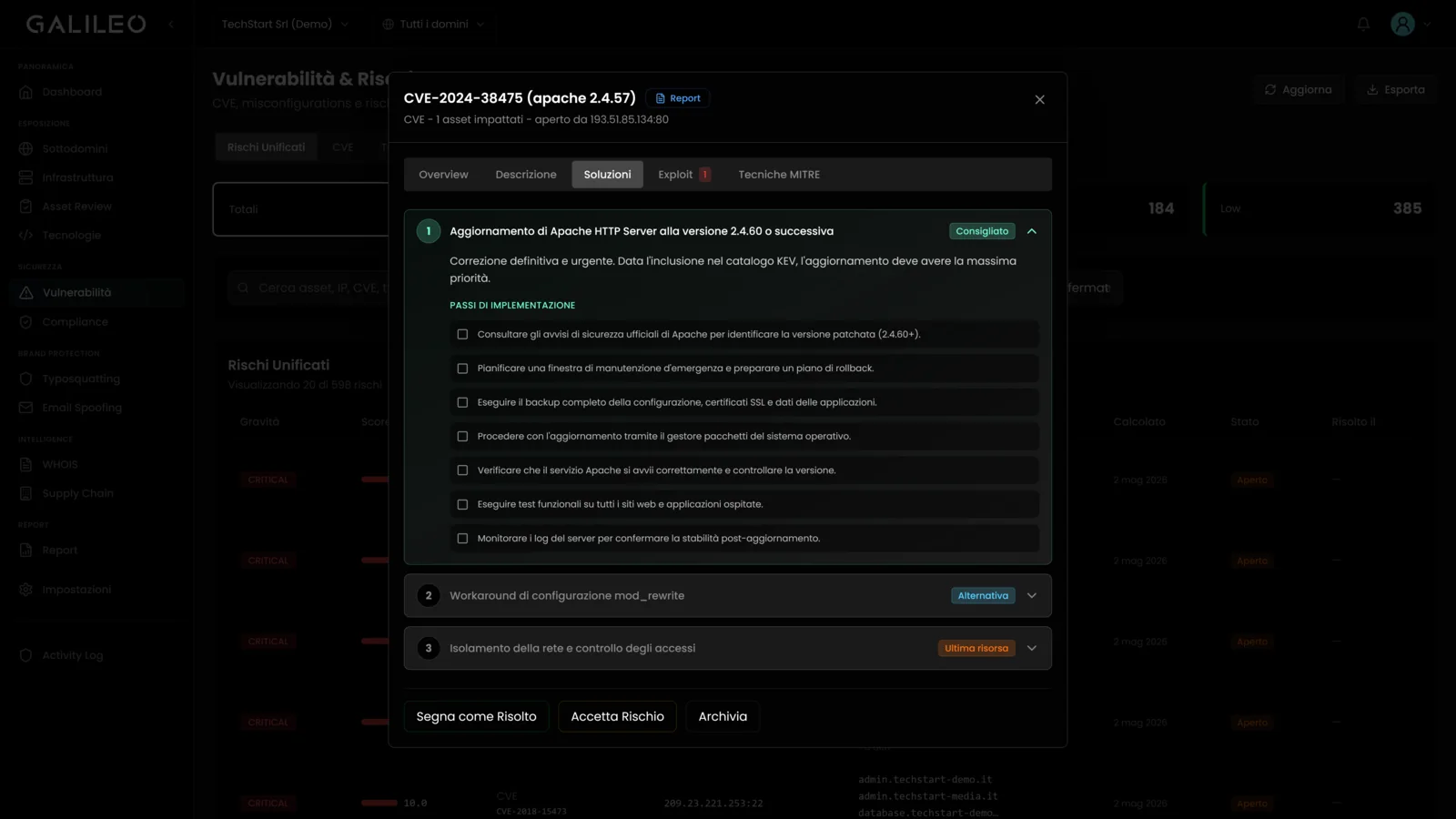
NIS2 evidence, generated continuously
Galileo integrates cyber exposure management and NIS2 compliance in a single platform, optimizing processes and turning every useful data point for attack prevention into NIS2 evidence
From exposures to NIS2 priorities
Galileo assesses each asset’s criticality, exposure, and potential impact to identify the technical priorities relevant to NIS2.
On-demand audit-ready reports
At any time the platform generates structured reports with technical evidence, timelines, and remediation status.
Exposure history
Galileo maintains a complete, verifiable history of how the perimeter has evolved over time.
Compliance change alerts
New exposures are linked to the relevant NIS2 measures.
The answers you're looking for
What is CTEM (Continuous Threat Exposure Management)?
CTEM is a cybersecurity framework that organizes cyber exposure management into five continuous phases: Scoping, Discovery, Prioritization, Validation, Mobilization. Unlike traditional Vulnerability Management, CTEM is a continuous cycle that integrates risk contextualization and operational remediation.
How is Galileo activated?
Activation starts by defining the perimeter and registering the domains to monitor. Galileo then starts discovery and organizes assets, evidence, and priorities in the dedicated workspace.
Does Galileo integrate with the tools I already use?
Yes. Galileo provides APIs to integrate exposure data, priorities, and remediation into the organization’s existing workflows and operational tools.
Are agents required on internal assets?
No. Galileo observes the external perimeter through passive and active discovery, without requiring agents or internal collectors. Activities are performed on the authorized perimeter according to defined scanning rules.